
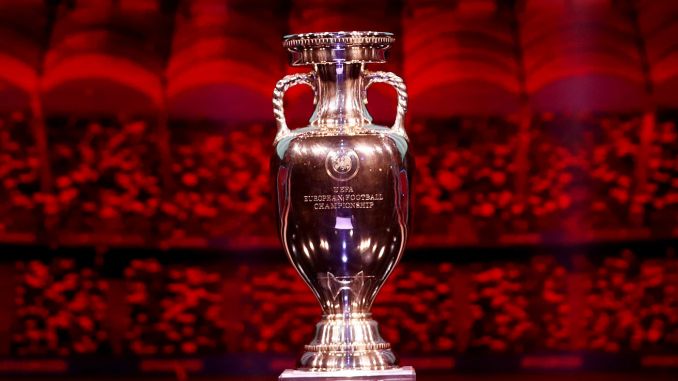
With Euro 2020 set to kick off this weekend, we bring you the ultimate guide to Euro 2020 from host venues to teams and even referees.
24 teams will do battle across the next month in a bid to be declared as champions of Europe across 11 host cities in the first-ever pan-European tournament, with previous editions having been hosted by selected countries either through joint hosting rights or as a individual single country host.
Littered with past former winners in teams like France, Germany and Spain amongst others as well as smaller nations plus two debutant countries, Euro 2020 certainly promises to be a packed month of sporting entertainment across 30 days.
Now, here is our ultimate guide to everything that you need to know ahead of the tournament opener on Friday 11 June 2021.
When Will Euro 2020 Take Place?
Euro 2020 will kick off on Friday 11 June 2021 as Turkey meet Italy at Stadio Olimpico, Rome, Italy, and conclude at Wembley Stadium, London, England, with the Final on Sunday 11 July 2021 which will serve as the conclusion of 51 matches scheduled to take place across 11 host cities in 30 days.
| Stage | Date |
| Group | 11-23 June 2021 |
| Last 16 | 26-29 June 2021 |
| Quarter-Finals | 2-3 July 2021 |
| Semi-Finals | 6-7 July 2021 |
| Final | 11 July 2021 |
How Does Euro 2020 Work?
Teams will participate in five stages with the finalists both playing seven matches in total en route to the final, so here is how the tournament will work.
Group Stage* – Six groups of four teams per group (Group A-F) with the top two placed teams in each group all advancing to the knockout stage, whereas four of the six teams who finish third in their groups will qualify too depending on their results.
Last 16 – 16 teams will contest this stage in a series of single knockout ties with the winners advancing to the Quarter Finals. In the event of matches finishing level after 90 minutes, 30 minutes of extra time will be played followed by penalties if still no winner is declared.
Quarter Finals – Eight teams will compete at this stage in four single leg knockout ties with the four winners all advancing to the Semi Finals. In the event of matches finishing level after 90 minutes, 30 minutes of extra time will be played followed by penalties if still no winner is declared.
Semi-Finals – Four teams will participate in this stage across two single leg ties with both winners advancing to the Final. In the event of matches finishing level after 90 minutes, 30 minutes of extra time will be played followed by penalties if still no winner is declared.
Final – Two countries will reach this stage with the winner of the single leg contest being declared the overall winners of the tournament. In the event of the match finishing level after 90 minutes, 30 minutes of extra time will be played followed by penalties if still no winner is declared.
*Although the paths for the knockout stages won’t be known until the Group Stage is concluded, here is a reminder of which countries feature in each Group.
| Group A | Group B | Group C | Group D | Group E | Group F |
| Italy | Denmark | Netherlands | England | Spain | Portugal |
| Switzerland | Finland | Ukraine | Croatia | Sweden | France |
| Turkey | Belgium | Austria | Czech Republic | Poland | Germany |
| Wales | Russia | North Macedonia | Scotland | Slovakia | Hungary |
Teams
24 teams qualified for the Finals with 20 teams sealing automatic qualification through the Qualifying Group Stage, whereas the last four teams came through Qualifying Play-Offs across Paths A-C.
Now here are the 24 teams who have qualified for the tournament in alphabetical order.
| Austria | North Macedonia |
| Belgium | Poland |
| Croatia | Portugal |
| Czech Republic | Russia |
| Denmark | Scotland |
| England | Slovakia |
| Finland | Spain |
| France | Sweden |
| Germany | Switzerland |
| Hungary | Turkey |
| Italy | Ukraine |
| Netherlands | Wales |
Host Cites
11 cities across 11 different countries will host matches throughout the tournament, with Wembley Stadium, London, England, set to host six matches throughout the competition, merely as a result of a reallocation of games following Dublin’s omission due to the Coronavirus pandemic.
| Stadium | City | Country | Matches |
| Johan Cruyff Arena | Amsterdam | Netherlands | Group Stage and Round of 16 |
| Olympic Stadium | Baku | Azerbaijan | Group Stage and Quarter Finals |
| Arena Nationala | Bucharest | Romania | Group Stage and Round of 16 |
| Puskas Arena | Budapest | Hungary | Group Stage and Round of 16 |
| Parken Stadium | Copenhagen | Denmark | Group Stage and Round of 16 |
| Hampden Park | Glasgow | Scotland | Group Stage and Round of 16 |
| Wembley Stadium | London | England | Group Stage, Round of 16, Semi Finals & Final* |
| Allainz Arena | Munich | Germany | Group Stage and Quarter Finals |
| Stadio Olimpico | Rome | Italy | Group Stage and Quarter Finals |
| Krestovsky Stadium | Saint Petersburg | Russia | Group Stage and Quarter Finals** |
| La Cartuja | Seville*** | Spain | Group Stage and Round of 16 |
* London will now host two matches in Round of 16 instead of the planned one match after Dublin was dropped as a host city due to concerns over spectator attendance due to Coronavirus pandemic.
** Saint Petersburg will now host matches in Group E as well as Group B after Dublin was dropped as a host city due to concerns over spectator attendance due to Coronavirus pandemic.
*** Bilbao was originally set to be Spain’s host city but concerns over spectator attendance due to Coronavirus pandemic forced a venue change to Seville.
Refereeing Teams
There will be 19 refereeing teams in use throughout the tournament selected from 14 countries, including Argentina as part of an exchange programme between UEFA and CONMEBOL with a group of Spanish teams selected for 2021 Copa America tournament in turn.
| Country | Referee | Assistant Referees |
| Argentina | Fernando Rapallini | Juan Pablo Belatti, Diego Bonfa |
| England | Michael Oliver | Stuart Burt, Simon Bennett |
| England | Anthony Taylor | Gary Beswick, Adam Nunn |
| France | Clement Turpin | Nicolas Danos, Cyril Gringore |
| Germany | Felix Brych | Mark Borsch, Stefan Lupp |
| Germany | Daniel Siebert | Jan Seidel, Rafael Foltyn |
| Israel | Orel Grinfeld | Roy Hassan, Idan Yarkoni |
| Italy | Daniele Orsato | Alessandro Giallatini, Fabiano Preti |
| Netherlands | Bjorn Kuipers | Sander van Roekel, Erwin Zeinstra |
| Netherlands | Danny Makkelie | Hessel Steegstra, Jan de Vries |
| Portugal | Artur Soares Dias | Rui Tavares, Paulo Soares |
| Romania | Ovidiu Hategan | Sebastian Gheorghe, Radu Ghinguleac |
| Romania | Istvan Kovacs | Vasile Marinescu, Ovidiu Artene |
| Russia | Sergei Karasev | Igor Demeshko, Maksim Gavrillin |
| Slovenia | Slavko Vincic | Tomaz Klancnik, Andraz Kovacic |
| Spain | Carlos del Cerro Grande | Juan Carlos Yuste Jimenez, Roberto Alonso Fernandez |
| Spain | Antonio Mateu Lahoz | Pau Cebrian Devis, Roberto Dias Perez del Palomar |
| Sweden | Andreas Ekberg | Mehmet Culum, Stefan Hallberg |
| Turkey | Cuneyt Cakir | Bahattin Duran, Tarik Ongun |
VAR will also be in use for the first time in any European Championship with 17 VAR Referees and five Offside VAR Referees from eight different countries selected.
| Country | VAR Referee | Offside VAR |
| England | Stuart Attwell, Chris Kavanagh | Lee Betts |
| France | Jerome Brisard, Francois Letexier | Benjamin Pages |
| Germany | Bastian Dankert, Christian Dingert, Marco Fritz | Christian Gittelmann |
| Italy | Marco Di Bello, Massimiliano Irrati, Paolo Valeri | Filippo Meli |
| Netherlands | Kevin Blom, Pol van Boekel | N/A |
| Poland | Pawel Gil | N/A |
| Portugal | Joao Pinheiro | N/A |
| Spain | Alejandro Hernandez Hernandez,
Juan Martinez Munuera, Jose Maria Sanchez Martinez |
Inigo Prieto Lopez de Cerain |
UEFA have also named six Support Match Officials and six Reserve Assistant Referees from six different European countries, with France and Italy the only countries to have representatives selected across all areas of refereeing teams for this tournament.
| Country | Fourth Official | Reserve Assistant Referee |
| Bulgaria | Georgi Kabakov | Martin Margaritov |
| France | Stephanie Frappart | Mikael Berchebru |
| Italy | Davide Massa | Stefano Alassio |
| Poland | Bartosz Frankowski | Marcin Boniek |
| Serbia | Srdan Jovanovic | Uros Stojkovic |
| Switzerland | Sandro Scharer | Stephane De Almeida |
Stat Attack
- Germany have participated in more Euro Grand Finals than any other UEFA team, winning and losing three of their six Final appearances apiece.
- Only one of 16 previous Finals in the European Championship has been settled on a penalty shootout, as Czechoslovakia beat West Germany 5-3 on penalties in 1976 Final after a 2-2 draw following extra-time.
- Netherlands, Denmark and Greece are the only three winners to have only won the competition once, with all three title winning successes coming in their maiden and currently only Final appearance in this competition.
- No team has made more appearances in the tournament without winning the competition than England, who have qualified for this competition for the tenth time and reached the Quarter-Finals stage in seven of their nine previous appearances.
- Only Spain have ever defended their Euro title in the following tournament, having won in 2008 before defending their crown in 2012 without conceding in either Final against Germany and Italy respectively.
- Finland and North Macedonia are making their maiden debuts at any major tournament in international football.
- Spain boasts the youngest squad age average for Euro 2020 at just 24 years and one month old, as well as the youngest player after Barcelona’s 18 year-old Pedri was selected in the final squad.
Leave a Reply