

In a special interview, we have spoken to 1978 Formula One World Champion, Mario Andretti on his journey from a refugee to life in motorsport.
Andretti who hails from Italy but moved to America as a teenager spoke candidly about his childhood growing up during World War II and the after-effects of the war’s conclusion as he and his family embarked on a tough journey to America in search of a new life.
The Italian-American also discusses how his passion for motorsport began plus various successes that he achieved throughout his career and what it means to see motorsport still running through younger generations of the Andretti family.
- You were born shortly after the start of WWII in Montona, Italy, so what was the early years of your childhood like growing up during WWII?

Andretti: “I spent the first 15 years of my life in Italy, the first seven years in Montona. My twin brothers and I were born in Montona, Italy in 1940, shortly after the start of World War II.
“We loved it there. We played happily on the streets. But when the war ended, the town was forever changed. Montona was ceded to Yugoslavia as part of the post-war political settlement, leaving us trapped inside a Communist country.”
- When the war ended, Yugoslavia claimed Montona as part of a post-war settlement. How did that impact you and your family as you embarked on a tough journey to ultimately secure a move to America?
Andretti: “We lost our home in Montona. My father had owned and operated several farms in Montona and he lost his livelihood. We stayed for a few years hoping things would work out, but we eventually left Montona as refugees when my brother and I were seven years old.
“Our first stop was a central dispersement camp in Udine. About a week later, we were dispatched to a refugee camp in Lucca. My parents had a difficult decision to make once territory in Italy became occupied by Marsh Tito and the hardline communists of Yugoslavia.
“Leaving Montona, going to the refugee camp, applying for American visas and years of waiting. On top of that, not knowing for sure what would happen if and when we ever got to America.”
- Looking back now, what was life in the refugee camp like from your perspective?
Andretti: “W e were refugees for seven-and-a-half years from 1947 until 1955 in the Italian city of Lucca. The refugee camp was an old monastery. It was crowded. Many families hung blankets to separate their quarters.
“You had to make do with the very basics, but we were always clean and dressed properly, and never hungry and never cold. My parents kept us happy and did their best to make sure our family was comfortable in our quarters.
“Even though we were living in the refugee camp, I thought Lucca was nice. There was a school, an opera house, a church. We were going to school and we could go out and about in Lucca.”
- During your time at the refugee camp, you attended the 1954 Italian Grand Prix at Monza, your very first F1 race. What do you remember about that day when you were able to see a F1 race for the first time?
Andretti: “Two guys who owned a parking garage near the refugee camp invited me and my brother to go with them to the Italian GP. It was unbelievable.
“That day is where my dream began. I decided that day that I wanted to be a race driver. In fact, not just a race driver. I wanted to be Alberto Ascari [1952 & 53 F1 champion]. Of course it was as impossible as anything you could think of at the time… A kid in a refugee camp dreaming the impossible dream of being a world champion.”
- 1955 saw you and your family move to Pennsylvania, USA. You and your brother soon decided to build your own racing car. How amazing was it to see the car come together?
Andretti: “When the car started to come together, it felt like our dream was becoming reality. The dream drove it all. Pure passion. Manic pursuit of our dream to be race drivers.”
- The swinging sixties saw your career swing into its glory years with notable wins including 1967 Daytona 500 then 1969 Indy 500 alongside your F1 debut at Watkins Glen in 1968. What was this time of your career like as a young driver making huge strides on the racing scene?

Andretti: Winning the Daytona 500 and Indy 500 and putting the car on pole in my debut in Formula One. These things changed my life. Things were just happening to go my way in the 60s. I had fought so hard and still had to put up a great fight for everything, but so many things were going in the right direction.”
- You continued to race in multiple series in the early 70s and claimed your first F1 win at the 1971 South African GP with Ferrari. How special was that victory for you personally?
Andretti: “I was the third driver on the team and I brought that car home first. The third driver doesn’t always get the best car. Jackie Stewart finished second to me, so as a first Formula One victory, it couldn’t have been any better than that – winning with Ferrari and Jackie Stewart second.”
- 1976-78 saw you experience a momentous time at Lotus with home victories in 1977 at Long Beach and Monza, before being crowned world champion in 1978 at Monza. How special was those particular moments for you given that your racing dream began at Monza in 1954?
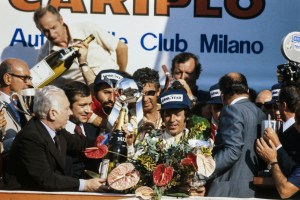
Andretti: “Obviously winning the World Championship. But you can imagine the satisfaction from winning in Monza where the dream of being a race driver began for me, and winning in the United States where we had immigrated to start a new life.”
- Over the decades, you have claimed so many records but which one has the most meaning to you?
Andretti: “The trifecta. Winning the Daytona 500, the Indianapolis 500 and the Formula One World Championship.”
- Across the decades, you have seen many drivers come and go in F1. Which drivers has impressed you the most whether on style or overall driving ability?
Andretti: “I would not choose. I could not name just one. There are too many who have impressed me. So many great drivers. I wouldn’t mention any by name because the list would be long and I might forget someone unintentionally.”
- Younger generations of your family have gone on to pursue motorsport as race drivers and team owners as your son – Michael now owns Andretti Autosport. How special is it to have motorsport continue through multiple generations?
Andretti: “It’s very special to see every generation succeed at whatever they pursue. Of course, I am very proud at the success each of them has achieved.”
Special thanks to Mario for kindly taking the time to participate in this interview.
Leave a Reply