


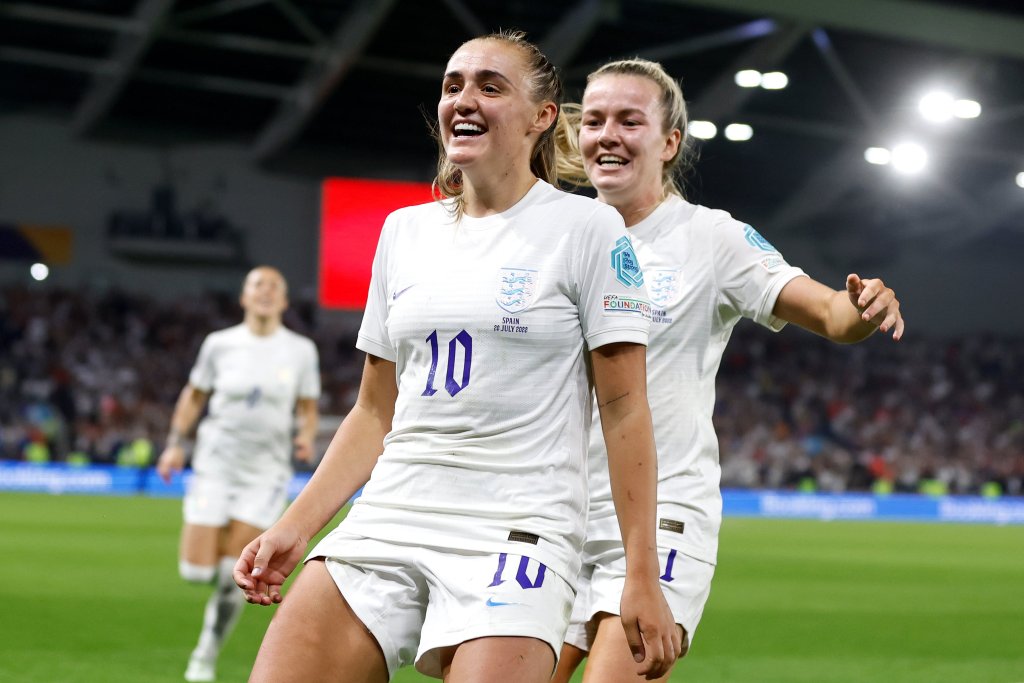
As England prepare to meet Germany in the 2022 UEFA Women’s Euro Final, here is a look at where the Final will be won or lost.
With tournament hosts, England heading into the match as in-form title favourites boosted by a buzzing build-up atmosphere across the country, there is a real belief that this is the Lionesses’ time to finally end 56 years of national footballing hurt on the international stage.
Germany on the other hand are in their ninth UEFA Women’s Euro Final so will have the experience of success to motivate them, as well as the heartbreak which their men endured in 1966 at Wembley at England’s hands.
Throw in unsolved issues like Golden Boot and Golden Glove honours between players within these two teams, it leaves plenty of spicy battles which could prove crucial in determining where this final is won or lost in front of a sell-out crowd.
Mead vs Popp


With England’s Beth Mead and Germany’s Alex Popp both battling for the Golden Boot with six goals apiece, – Mead currently sits ahead by virtue of more assists – these two players know that if they score then it could well win their team the title.
Both players however do have different qualities which separates them because whilst Mead is dangerous in her ability to press high up the pitch, Popp is superior in the defensive aspect with her pacey runs when tracking back to help her team out when defending.
With that in mind, Mead is going to have to be at her absolute clinical best when on the attack because whilst Popp has the edge defensively, the German is still just as dangerous when it comes to getting involved in attacks which England’s defence must be aware of.
Popp also has scored four of her last seven international goals in London which began with her opening strike in a 2-1 friendly win over England at Wembley in November 2019, underlining just how much she has enjoyed scoring in the Capital.
Now if we break down their six goals based on the manner in which they found the net, Mead has proven the more versatile with two goals scored on right and left foot apiece, whilst one goal apiece came from a header and an alternate goal.
Popp though is the more dangerous aerially with four of her goals coming from headers which provide further headaches for England’s defence, yet she has the advantage of playing as a central striker whereas Mead is a winger who was well positioned for her headed goal.
| Player/Goal | Right Foot | Left Foot | Head | Other |
| Beth Mead | 2 | 2 | 1 | 1 |
| Alexandra Popp | 0 | 2 | 4 | 0 |
Either way, Mead and Popp will be a huge battle to watch out for in Sunday’s Final given how crucial a role both players have played in the runs of their respective teams to reach this Final.
Earps vs Frohms

Whilst Mead and Popp fight over the Golden Boot, there is another award to still be settled as England’s Mary Earps and Germany’s Merle Frohms scrap for the Golden Glove award, having kept five clean sheets apiece across the tournament.
Earps though didn’t really have much to do in the Group Stage but has been the hosts’ rock in knockout wins over Spain and Sweden, with several cracking saves which proved crucial against robust tough competition.
Frohms meanwhile has had to be at her best from the very start given the extremely difficult opposition that Germany faced in Group B, so will be mentally well prepared to expect another competitive contest where she will need to be at her best.
If look at their distribution and saves, it is notable that despite Frohms attempting and completing more passes, she has been 10.6% less clinical than Earps in her distribution which could prove a weakness if England’s attack press high and are able to quickly unleash shots on goal.
Earps also has the edge when it comes to the number of saves because despite England coming through an easier group, she has made more saves than Frohms despite both goalkeepers each conceding just once this tournament.
| Player | Pass Accuracy (%) | Passes Attempted | Passes Completed | Saves |
| Mary Earps | 93.2 | 104 | 97 | 10 |
| Merle Frohms | 82.6 | 168 | 141 | 7 |
For those who are intrigued by the fitness aspect heading into the Final, Earps looks the more fitter given England’s general dominance in possession in their five matches so far – except in their Quarter-Final win over Spain where they only had 42% yet somehow got the victory.
Frohms though has been crucial to Germany’s success despite only making seven saves because Germany had just 30% possession in their Group B win over Spain, yet Frohms’ goalkeeping and excellent defending secured them a clinical win to top their group.
On that note, both goalkeepers will have a crucial role to play in the outcome of this match just like Mead and Popp will up front, should England and Germany both stick to their possession-based attacking tactics.
Substitutions


Although it is easy to focus on key battles within the starting eleven of both teams, the substitutes bench could prove just as crucial as those who start, especially if changes are needed in the second-half for versatile players which is where squad depth becomes clearer.
From an attacking perspective, England’s bench currently looks to have the better substitute quality with five of their goals scored from off the bench, of which four goals came from Alessio Russo underlining how dangerous she is as an impact substitute.
Germany’s three substitute produced goals meanwhile all came in the Group Stage from Popp, Lena Lattwein and Nicole Anyomi, which is a slight concern compared to England yet underlines the quality of their starting line-up.
This match though is a Grand Final so for Germany to enter the match without a substitute having found the net in the pressure-filled knockout stages is a worry, whereas England have the edge overall in that aspect with Ella Toone and Russo who could make the difference.
On the other hand, Germany’s substitutes have done enough to help secure wins over Austria and France in the Quarter-Final and Semi-Final stages, which offers hope that they can spring a surprise if needed instead of helping shore up victories.
Coming back to the point of this game being the Grand Final, crowd atmosphere and the emotions of the occasion will also play psychologically on the minds of both teams, yet for substitutes it can be motivation for them to come on and go down in history as a title-clinching hero.
With that plus the importance of versatile squad depth and substitution impact quality all set to play a factor, I think that this match could well be settled just as much in the substitution choices of Sarina Wiegman and Martina Voss-Tecklenburg as it will in their starting line-ups.
Psychology

Beyond the obvious positive mental aspects of reaching the Final, it is important for every player within each team to focus on playing the game and not the occasion, which is easier said than done in front of a raucous crowd – especially if the tournament hosts are in that Final.
England though have additional expectations upon their shoulders because they will have to once again shoulder the demanding pressure of a nation, of whom are dreaming of a first title since their male counterparts won 1966 FIFA World Cup on home soil.
One positive is that between them all, this England team have amassed 143 titles between them at College and Club levels, yet the international stage is entirely different territory but they all know how to win and just need to bring that experience to this final showdown.
This team also have already sniffed international success under Wiegman at home as a group after the majority of the squad won the 2022 Arnold Clark Cup in February, with only Lotte Wubben-Moy, Chloe Kelly and Bethany England not part of that squad for various reasons.
12 players of this current England squad were also part of the 2019 SheBelieves Cup title winning squad, further underlining their improved winning mentality but they’re now still unbeaten since Wiegman became manager in September 2021.
That unbeaten form has also seen them net 104 goals in 19 matches and fail to score just once in which they drew 0-0 against Spain in February, which only serves as further belief that they can come out and cause major issues for Germany if they play at their very best.
Germany however are proven winners – having never lost any of their eight previous appearances in the final of this competition – yet only four players within this squad was part of the last German team to taste success which came at 2016 Olympics.
Manager, Voss-Tecklenburg however is in the same boat as the majority of her players in terms of this being their first international final, which will only serve to create further unity amongst this squad.
This Germany team will also be aware of Wiegman’s unbeaten record in this competition as a manager – having won with 2017 hosts, Netherlands on home soil – which she will be looking to replicate with England so that will only further motivate Germany to chase the title.
It also won’t be lost on both teams that this weekend is exactly 56 years to the very weekend that England beat Germany at Wembley Stadium to win the men’s 1966 FIFA World Cup, which adds an additional psychological edge to this battle from an omen perspective.
Psychology therefore is set to potentially play a huge part in the mindsets across all players and managers, which could ultimately prove decisive in determining who handles the pressure best and go on to become champions.