


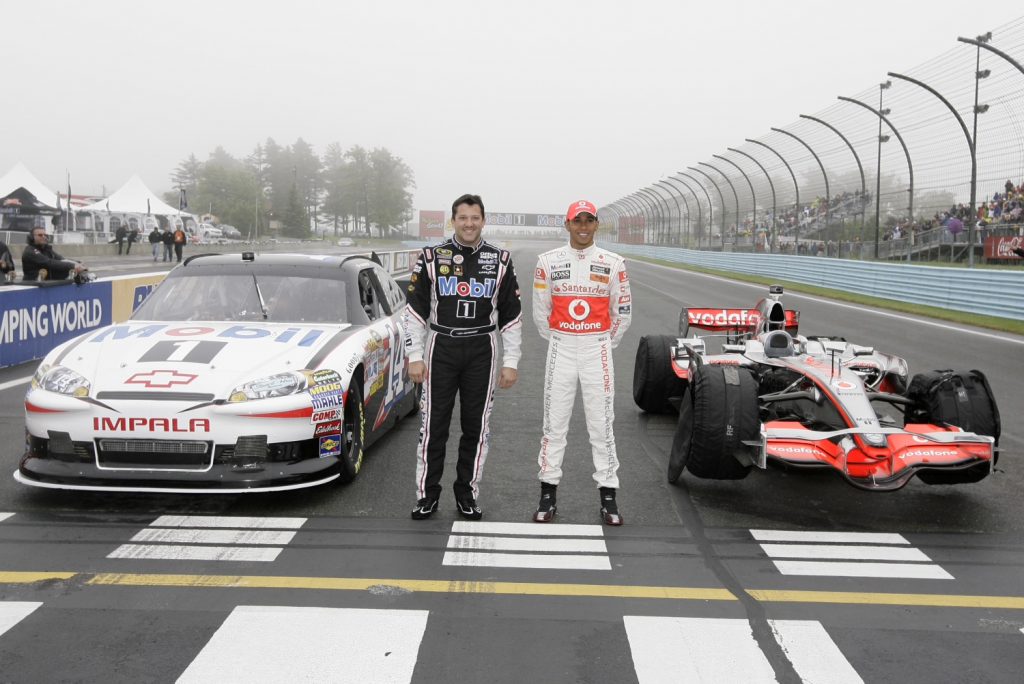
Formula One is currently midway through its winter break but NASCAR are preparing for a new season which commences in a few weeks time, so how similar are F1 and NASCAR?
There has often been a fiercely fought debate between which series is better than the other, with F1 and Indycar often being compared but I believe that they’re very different so F1 and NASCAR are more comparable.
People say that NASCAR is easy as just mainly racing round in circles but it’s actually not as easy as people like to think it is.
Format


F1 is spread out across a three day weekend with Free Practice (FP1) & (FP2) held on Fridays (Thursday in Monaco), before FP3 is held on Saturday mornings ahead of a three knockout stage qualifying session on the afternoon (unless rain forces postponement to Sunday morning).
Qualifying is also ran under parc ferme rules which prohibits the change of setup without incurring penalties, unless exemption is granted by stewards.
Like NASCAR, F1 races are held on Sunday over a set race distance but the latter has a two-hour time limit, with a four-hour overall time limit to account for red flags.
NASCAR however hold their qualifying session on Friday afternoons after FP1 with the Saturday devoted to practice, although there is no FP2 if there is a Saturday night race which is a huge differentiation from F1.
NASCAR races however can vary in length from 90 minutes to four hours depending on the track and conditions, with a majority of races being held across 500 miles.
Flags
Embed from Getty ImagesIn F1, there is a series of flags to alert the drivers whilst on track more often than not most dont get used, so please find a rundown of the flags and meanings below.
- Checkered Flag – Shown at end of race to the winner although it can be waved during a red flag to indicate that the race has finished and won’t be restarted.
- Green flag – Indicates that the track is clear for full speed racing.
- Yellow flags – Used to warn drivers to slow down and no overtaking permitted due to an incident on track. Double waved yellows however are waved at the scene of the incident because Marshals and a recovery vehicle are likely to be on track recovering the car.
- Blue flags – Indicates that a lapped car must move over to let faster cars pass who are coming up behind him. A penalty however could be issued if the blue flags aren’t observed within three corners of being shown, unless pre-race notes dictate otherwise.
- Red flag – Used when a session needs to be stopped due to an incident which requires a lot of cleaning up, for track repairs or for dangerous weather conditions.
- Safety Car (SC) and Virtual Safety Car (VSC) – Shown in conjunction with a yellow flag to indicate that the saftey car is on track, or the virtual safety car period is occurring if the incident can be quickly cleared within 1-2 laps.
- Red and yellow striped – Indicates a slippery surface due to either oil, water or loose debris. This flag can also be rocked from side-to-side to indicate that an animal is on track.
- Black Flag – Indicates that a driver is disqualified and is accompanied by the driver’s car number.
- Black with orange circle – Shown to a car which has substantial damage and needs to pit immediately, whilst being accompanied by the driver’s car number when shown.
- Black and white – Warning for a driver for unsportsmanlike behaviour like aggressive driving or cutting corners repeatedly. If not adhered to then a black flag could follow.
There are various penalties attached to some of these flags such as a grid penalty or race bans depending on the offence and reasoning as to why the offence was committed.
Embed from Getty ImagesNASCAR however have two differences such as the lapped car flag being a blue flag with diagonal strips, whilst if a caution unfolds during the closing stages then a green-white-checkered flag is used to create a two lap sprint
- Blue and diagonal yellow flag – Used to indicate that a car is about to be lapped and is quite similar to the F1 flag if not for the diagonal yellow lines.
- Green-white-checkered flag – Shown to create a two lap sprint if there is a caution during the final laps, although the race is finished if a caution occurs during the two lap sprint now the overtime rule has been scrapped.
Points System
In all motorsport series, there are various points systems of which all have evolved since each series first began over the decades.
The points systems have also gone through changes with F1 points system displayed below
1st – 25 points, 2nd – 18 points, 3rd – 15 points, 4th – 12 points, 5th – 10 points, 6th – 8 points, 7th – 6 points, 8th – 4 points, 9th – 2 points & 10th – 1 point.
Another bonus point is awarded to the driver who posts the fastest lap of the race, on condition that he finishes in the top ten.
NASCAR however have a radically different but fairer points system to that of F1 in that they have three stages within each race in which the top ten will all be awarded points.
Embed from Getty ImagesThe first two stages have a 10, 9, 8,7, 6, 5, 4, 3, 2, and one point system from first down to tenth placed drivers which are added to the points from the final stage to reveal a full race result.
Bonus points however can be earned throughout the race via the following methods;
- Five bonus points awarded to the race winner.
- One bonus point awarded to the winner of stages 1/2
These bonus points however aren’t added to the driver’s points tally until the post-season starts, and will be carried over across the first three Play-Off rounds.
The race result points system sees the winner receive 40 points and the second-placed drive collect 35 points and so on downwards until we get to the last driver, who will be given just a single point.
In the event that there are more than 36 drivers, those finishing 36th or less will all receive a point each.
Penalties
Like F1, Nascar have a variety of penalties with quite a few similarities between series, which you can find below with reference to NASCAR regulations;
Stop and Go Penalty
- Removing equipment from assigned pit area (9-15O).
- Speeding on pit road during pass-through penalty (9-15R).
One Lap Penalty
- Car/truck pitting out of the assigned pit box (9-15F) (NASCAR may relax the rule at tracks with shorter pit boxes)
- Passing the the safety car (10-4D) (except for cars being subjected to the wave-around, or at some tracks where the radius of pit road is shorter than track, as in Martinsville and Bristol, where the pit road speed limit applies, and the safety car may be passed.)
- Pulling up to pit (9-15A) — (drivers must maintain position in relation to field or face penalty, again rule differs at Martinsville and Bristol)
- Refuelling car before race start OR when before the designated race distance, as in a competition caution called because of weather, passes (9-6D and 9-6E). Additional laps may be added to penalty.
Pass-Through Penalty
- Jumping any green flag (10-2A)
- Passing after specific point on the “One to Go” signal (Turn 3 of most ovals, Turn 2 at Pocono, Turn 10 at Sonoma or Watkins Glen) (9-11)
- Passing on a start or restart (before start/finish line) (9-11)
- Illegal Lane Change on restart (9-11)
- Unapproved mechanical adjustment (flaring of rocker panels most notably) (10-7-1-1).
- Penalty only under yellow condition, enforced on the second lap following a restart, in addition to starting at the tail end of the field during for that restart. Under green condition, NASCAR will not allow the car on the track until the car is repaired legally.
- Failure to make qualifying attempt because of numerous failed pre-race technical inspections.
- Three failed inspection attempts also involves ejection of crew member.
- Four failed inspection attempts also involved a ten-point penalty.
Thank you for taking the time to enjoy this article and please leave a comment below if you would like to add your view to this debate.